Search
Contact Us

Successfully meeting the changing needs of every citizen
The challenges facing local government customer service are increasing, driven by changing community demands, financial pressures, and a need for greater flexibility. Modernising the community experience is crucial, but out-of-date technology can prevent the required transformation. We explain the steps to take to transform the local government community experience through the deployment of modern, future-proofed contact centre solutions.
Why pressure is growing on local government community experience
The service provided by local government to residents and businesses has always been important. However, three critical emerging factors show how councils are seen by their community:
- What customers want is changing, with higher expectations of the service they receive. They judge local government against the same high standards as the most advanced e-commerce business, demanding a personalised, rapid and omnichannel service designed around their needs. However, expectations are not being met: Deloitte reported a 21% percentage-point gap between private and public sector customer satisfaction [1].
- Pressure on budgets mean that local government bodies need to reduce operating costs, so that customer service has to do more with less, without impacting quality.
- Local government needs to be ready for the future and increase operational flexibility as trends such as digitalisation and AI impact how they work and what their communities require.
All of these factors add to the existing demands on local government customer service, such as the wide range of areas they cover and the need to cater for all demographics within the community. Just 26.3% of Australian citizens believe that local government online service has improved between 2021-26, highlighting the gap between expectations and reality [2].
Delivering on these changing requirements starts with the right technology. However, many local government organisations struggle with overburdened legacy contact centre solutions that cannot cope with today’s requirements. Local governments need to embrace modern customer service to deliver the right experience to everyone in the community.
The challenges to delivering a modern community experience
Modern customer service is personalised, omnichannel, efficient, and designed around the needs of every consumer. In the case of local government this means meeting the needs of the community equally, from those happiest with channels such as telephone or face-to-face to today’s digital generations. It harnesses technology, including AI, to improve the customer experience, increase overall efficiency, and make the working lives of employees easier, while helping them collaborate with colleagues across the organisation.
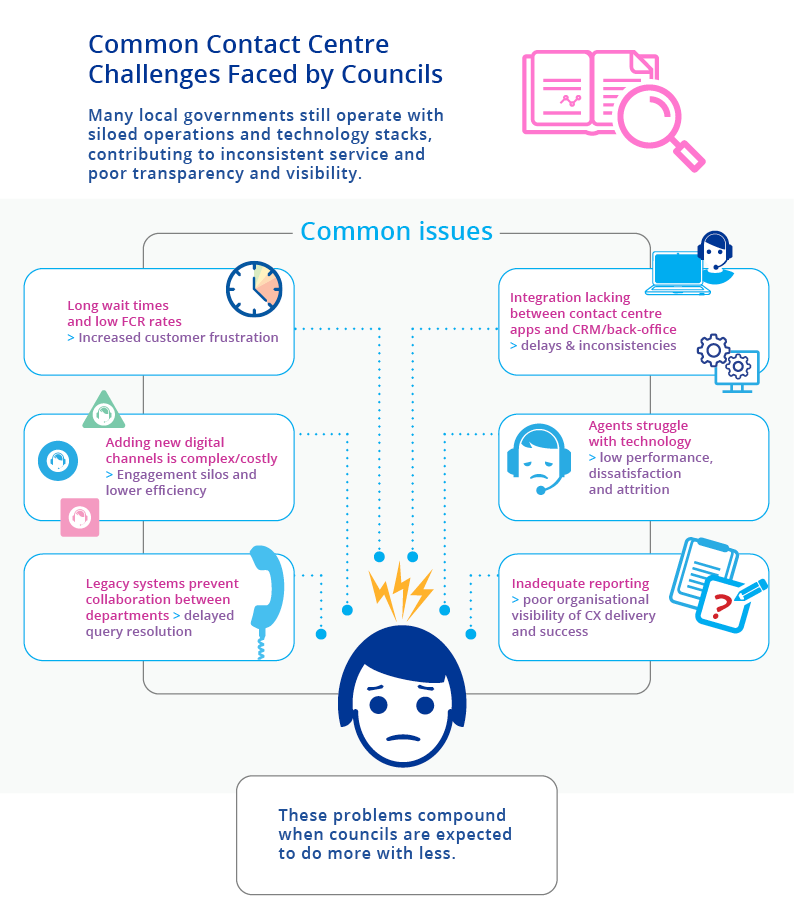
Legacy contact centre technology and siloed operations are simply not designed to deliver this modern community experience. For example, Accenture [3] reports that 62% of employees say their ability to deliver core services is affected by inefficient processes. When it comes to service, councils are battling a range of common issues, including:
How to deliver a modern experience in local government
Modernising contact centre technology effectively benefits everyone, delivering a better experience for the community, while boosting internal efficiency. Given its scale, though, local government customer service leaders may feel daunted by the challenge of delivering an improved service with the resources at their disposal.
However, approaching the task in steps makes it simpler and achievable.
By working with experienced partners who offer a full technology portfolio, local government can modernise at a pace that works for them (and their residents), derisking the process, building a foundation for the future, and reducing costs. Taking a step-by-step approach, demonstrating success, and learning from the experiences of other councils is vital.
While technology is not the only component of a modern customer experience, it does provide the bedrock for delivering the service that the community expects. Therefore, look for a vendor that can offer these key capabilities:
- Omnichannel engagement. Not just providing disconnected, siloed digital channels, but enabling interactions to easily move between them to deliver joined-up service.
- A full set of digital channels to cover the needs of your residents, from email and social media to live chat and video. Afterhours support can be delivered on live chat and voice channels by AI tools such as virtual agents, which can efficiently process enquiries 24/7, handing off unresolved contacts to the contact centre team for in-hours follow up as required.
- Choice of deployment models. The ability to choose between on-premises, cloud or hybrid solutions, dependent on your needs.
- Reliability and resilience. Proven uptime from an easy-to-manage solution that doesn’t require extensive IT support.
- Agent engagement. A straightforward, intuitive interface that is simple to learn and enables agents to focus on the customer, not navigating multiple screens and systems.
- Reporting and quality assurance. Built-in monitoring and quality assurance tools that underpin agent coaching and improvement along with detailed performance reporting for internal and management use.
- Integration with business systems. Deep links with CRM and back-office solutions keep the contact centre fully connected to customer data. This not only empowers agents with the latest, most relevant customer information but enables efficient hand-off or input from other departments, ensuring better, faster resolution. Close integration with platforms such as Microsoft Teams also ensures effortless communications and collaboration with other teams.
- Responsible, effective AI. AI applied to real business problems where it delivers actual results, from virtual agents to automate and deflect routine queries, to human agent support, and AI quality management to deliver a holistic view of agent performance.
- Deep knowledge and commitment to local government. Look for a vendor that has a strong track record in the sector, backed up by customer testimonials, and a detailed roadmap for future innovation.
- The highest levels of data security and compliance to protect citizen data, ensure data sovereignty and meet the needs of local privacy regulations.
Taking the next step in local government service modernisation
At a time of increasing pressure, local government organisations must focus their limited resources on the right areas, while meeting the varied requirements of all their customers. Delivering seamless, personalised service is vital. For many citizens contacting customer service is their primary experience of local government, meaning that how their interactions are handled is central to building trust and satisfaction.
The good news is that effective technology foundations can combine better service with greater efficiency. And that modernisation can be carried out in a low-risk, step-by-step process that meets today’s needs and underpins future growth.
Enghouse Interactive: Supporting the modernisation needs of local government
Enghouse Interactive’s modern contact centre solutions are perfectly designed to support the changing needs of local government. Offering a full portfolio of solutions, available through the cloud or on premises, our technology delivers reliability, ease-of-use, and innovation through AI. We support over 300 local government organisations across the globe, from cities and councils to regions and counties and have over 40 years of experience in meeting client needs.
Ready to modernise your council’s customer service? Download the Local Government Buyer’s Guide to discover the practical steps, technologies and partner capabilities you need to meet rising community expectations.
About the Author

With more than 20 years’ experience in contact centre service and technology, Pete has worked across support engineering, professional services and presales roles in New Zealand and the UK, bringing deep technical knowledge and practical insight into the challenges service teams face. Pete is passionate about helping organisations understand and apply modern contact centre technology, automation and AI to improve customer engagement while increasing efficiency and agent experience.
References
- Deloitte: Public service modernization
- TechnologyOne and IBRS: Australian Digital Citizens 2025
- Accenture: Reimagining public services in the age of AI: Experience is everything
Published In
GovernmentGet in touch!
Simply provide a few details and one of our experts will be in touch with you shortly.

Thank you!
You have successfully subscribed to our newsletter.
Sign up here to watch your selected video as well as gain access to the other videos listed here
Sign up here to watch your selected video
Sign up here to watch the videos as well access to more Tips 'N' Tricks videos
Get your free download